xv6系统启动过程
启动qemu和gdb
一个终端(设定一个CPU,方便调试):1
2
3grand@Lubuntu ~/xv6-labs-2020 (dev)> make qemu-gdb CPUS=1
*** Now run 'gdb' in another window.
qemu-system-riscv64 -machine virt -bios none -kernel kernel/kernel -m 128M -smp 1 -nographic -drive file=fs.img,if=none,format=raw,id=x0 -device virtio-blk-device,drive=x0,bus=virtio-mmio-bus.0 -S -gdb tcp::26000
另一个终端:1
2
3
4
5
6
7
8
9
10
11
12
13
14
15
16
17
18
19grand@Lubuntu ~/xv6-labs-2020 (dev)> gdb-multiarch kernel/kernel
GNU gdb (Ubuntu 9.2-0ubuntu1~20.04) 9.2
Copyright (C) 2020 Free Software Foundation, Inc.
License GPLv3+: GNU GPL version 3 or later <http://gnu.org/licenses/gpl.html>
This is free software: you are free to change and redistribute it.
There is NO WARRANTY, to the extent permitted by law.
Type "show copying" and "show warranty" for details.
This GDB was configured as "x86_64-linux-gnu".
Type "show configuration" for configuration details.
For bug reporting instructions, please see:
<http://www.gnu.org/software/gdb/bugs/>.
Find the GDB manual and other documentation resources online at:
<http://www.gnu.org/software/gdb/documentation/>.
For help, type "help".
Type "apropos word" to search for commands related to "word"...
Reading symbols from kernel/kernel...
The target architecture is assumed to be riscv:rv64
0x0000000000001000 in ?? ()
在gdb终端上查看源代码和汇编1
layout split
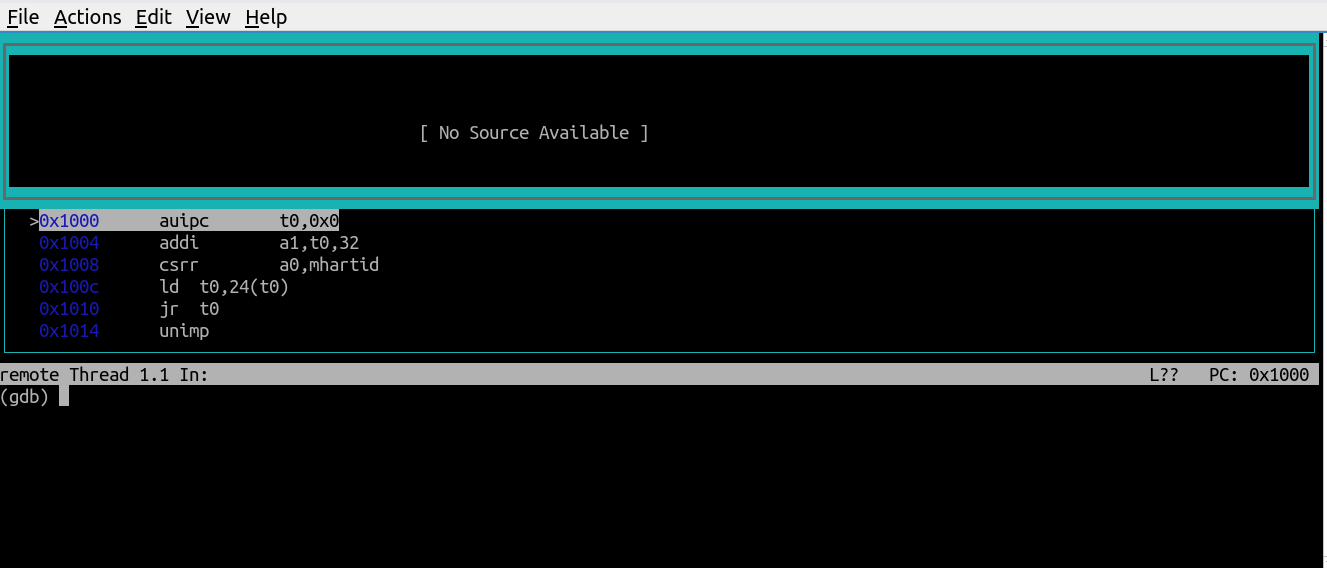
entry
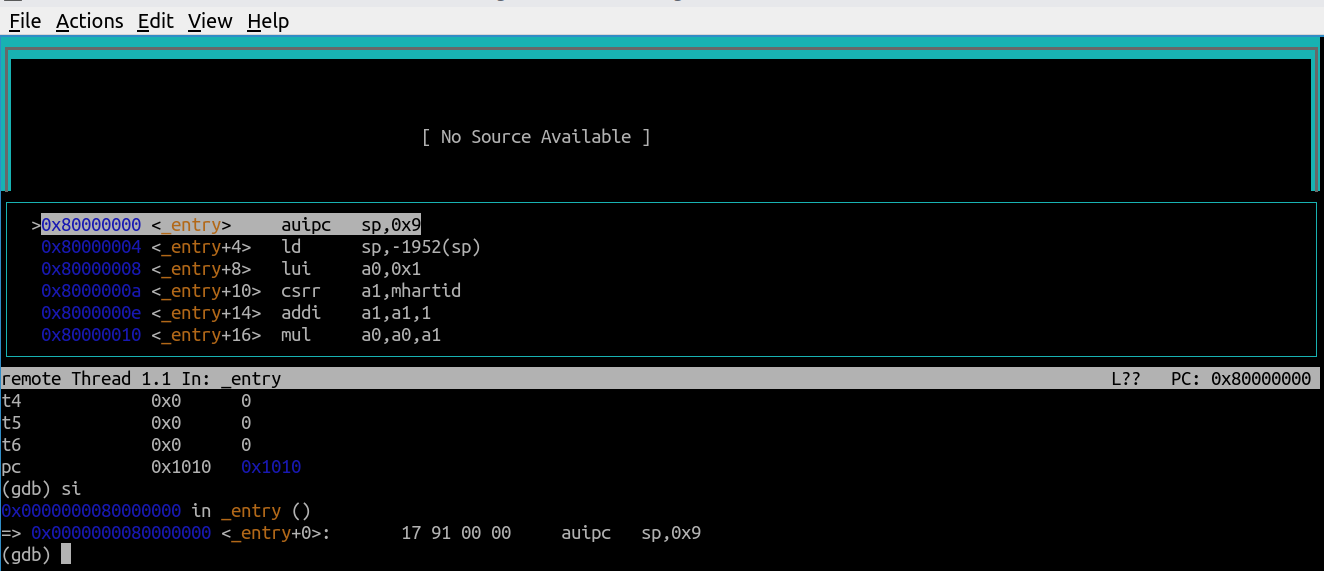
- 在entry加一个断点
- b _entry
- 可以单步调试也可以Continue
- si
- c
kernel/entry.S1
2
3
4
5
6
7
8
9
10
11
12
13
14
15
16
17
18
19
20 # qemu -kernel loads the kernel at 0x80000000
# and causes each CPU to jump there.
# kernel.ld causes the following code to
# be placed at 0x80000000.
.section .text
_entry:
# set up a stack for C.
# stack0 is declared in start.c,
# with a 4096-byte stack per CPU.
# sp = stack0 + (hartid * 4096)
la sp, stack0
li a0, 1024*4
csrr a1, mhartid
addi a1, a1, 1
mul a0, a0, a1
add sp, sp, a0
# jump to start() in start.c
call start
spin:
j spin
start
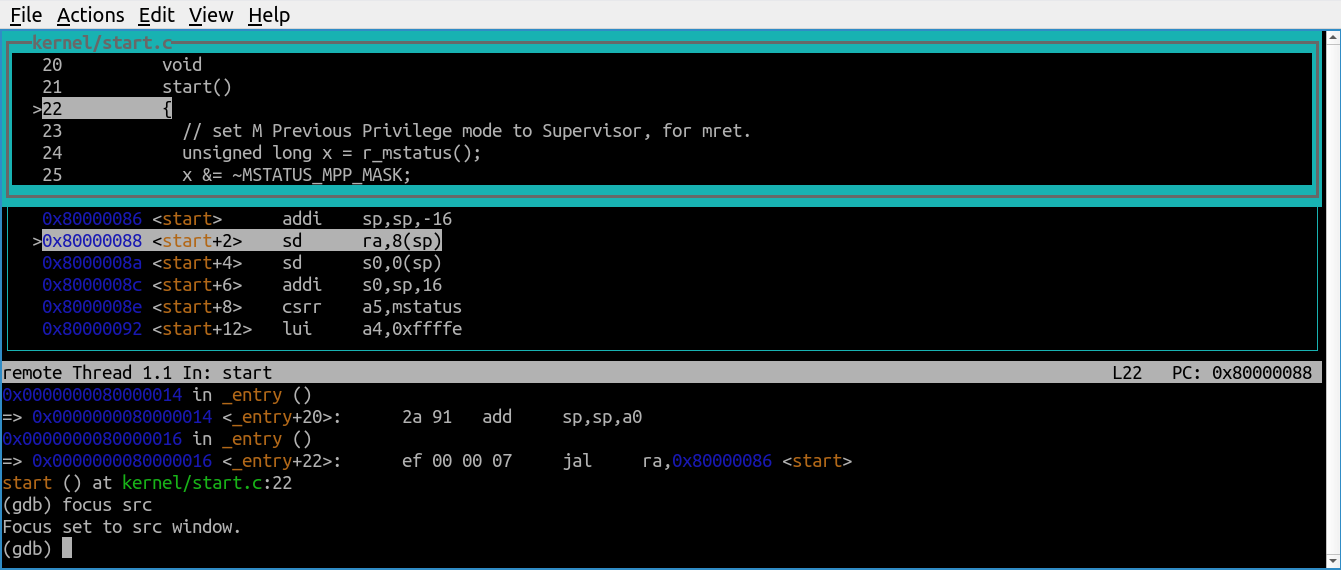
- focus src
- 在main加一个断点
- b main
- 可以单步调试也可以continue
- s
- c
kernel/start.c1
2
3
4
5
6
7
8
9
10
11
12
13
14
15
16
17
18
19
20
21
22
23
24
25
26
27
28
29
30
31
32
33
34
35
36
37
38
39
40
41
42
43
44
45
46
47
48
49
50
51
52
53
54
55
56
57
58
59
60
61
62
63
64
65
66
67
68
69
70
71
72
73
74
75
76
77
78
79
80
81
82
83
void main();
void timerinit();
// entry.S needs one stack per CPU.
__attribute__ ((aligned (16))) char stack0[4096 * NCPU];
// scratch area for timer interrupt, one per CPU.
uint64 mscratch0[NCPU * 32];
// assembly code in kernelvec.S for machine-mode timer interrupt.
extern void timervec();
// entry.S jumps here in machine mode on stack0.
void
start()
{
// set M Previous Privilege mode to Supervisor, for mret.
unsigned long x = r_mstatus();
x &= ~MSTATUS_MPP_MASK;
x |= MSTATUS_MPP_S;
w_mstatus(x);
// set M Exception Program Counter to main, for mret.
// requires gcc -mcmodel=medany
w_mepc((uint64)main);
// disable paging for now.
w_satp(0);
// delegate all interrupts and exceptions to supervisor mode.
w_medeleg(0xffff);
w_mideleg(0xffff);
w_sie(r_sie() | SIE_SEIE | SIE_STIE | SIE_SSIE);
// ask for clock interrupts.
timerinit();
// keep each CPU's hartid in its tp register, for cpuid().
int id = r_mhartid();
w_tp(id);
// switch to supervisor mode and jump to main().
asm volatile("mret");
}
// set up to receive timer interrupts in machine mode,
// which arrive at timervec in kernelvec.S,
// which turns them into software interrupts for
// devintr() in trap.c.
void
timerinit()
{
// each CPU has a separate source of timer interrupts.
int id = r_mhartid();
// ask the CLINT for a timer interrupt.
int interval = 1000000; // cycles; about 1/10th second in qemu.
*(uint64*)CLINT_MTIMECMP(id) = *(uint64*)CLINT_MTIME + interval;
// prepare information in scratch[] for timervec.
// scratch[0..3] : space for timervec to save registers.
// scratch[4] : address of CLINT MTIMECMP register.
// scratch[5] : desired interval (in cycles) between timer interrupts.
uint64 *scratch = &mscratch0[32 * id];
scratch[4] = CLINT_MTIMECMP(id);
scratch[5] = interval;
w_mscratch((uint64)scratch);
// set the machine-mode trap handler.
w_mtvec((uint64)timervec);
// enable machine-mode interrupts.
w_mstatus(r_mstatus() | MSTATUS_MIE);
// enable machine-mode timer interrupts.
w_mie(r_mie() | MIE_MTIE);
}
main
- 在userinit打一个断点
- b userinit
- 单步调试或者continue
- s
- c
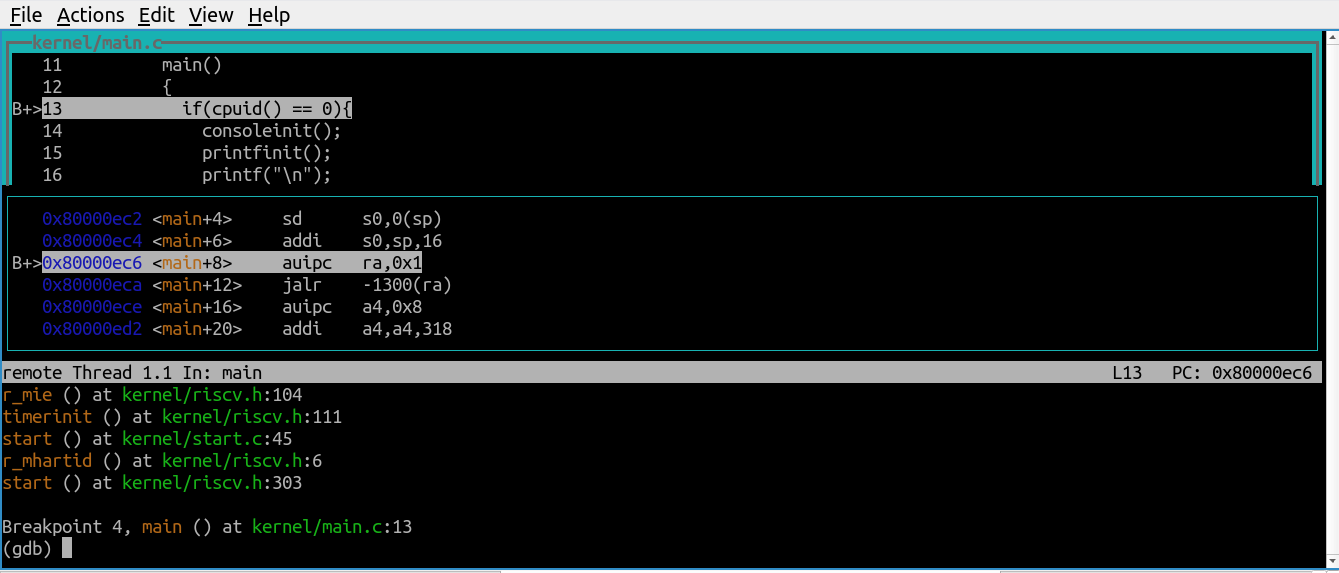
kernel/main.c1
2
3
4
5
6
7
8
9
10
11
12
13
14
15
16
17
18
19
20
21
22
23
24
25
26
27
28
29
30
31
32
33
34
35
36
37
38
39
40
41
42
43
44
45
volatile static int started = 0;
// start() jumps here in supervisor mode on all CPUs.
void
main()
{
if(cpuid() == 0){
consoleinit();
printfinit();
printf("\n");
printf("xv6 kernel is booting\n");
printf("\n");
kinit(); // physical page allocator
kvminit(); // create kernel page table
kvminithart(); // turn on paging
procinit(); // process table
trapinit(); // trap vectors
trapinithart(); // install kernel trap vector
plicinit(); // set up interrupt controller
plicinithart(); // ask PLIC for device interrupts
binit(); // buffer cache
iinit(); // inode cache
fileinit(); // file table
virtio_disk_init(); // emulated hard disk
userinit(); // first user process
__sync_synchronize();
started = 1;
} else {
while(started == 0)
;
__sync_synchronize();
printf("hart %d starting\n", cpuid());
kvminithart(); // turn on paging
trapinithart(); // install kernel trap vector
plicinithart(); // ask PLIC for device interrupts
}
scheduler();
}
第一个进程的初始化
- 在scheduler打一个断点
- b scheduler
- 单步调试或者continue
- s
- c
kernel/proc.c1
2
3
4
5
6
7
8
9
10
11
12
13
14
15
16
17
18
19
20
21
22
23
24
25
26
27
28
29
30
31
32
33
34
35
36
37// a user program that calls exec("/init")
// od -t xC initcode
uchar initcode[] = {
0x17, 0x05, 0x00, 0x00, 0x13, 0x05, 0x45, 0x02,
0x97, 0x05, 0x00, 0x00, 0x93, 0x85, 0x35, 0x02,
0x93, 0x08, 0x70, 0x00, 0x73, 0x00, 0x00, 0x00,
0x93, 0x08, 0x20, 0x00, 0x73, 0x00, 0x00, 0x00,
0xef, 0xf0, 0x9f, 0xff, 0x2f, 0x69, 0x6e, 0x69,
0x74, 0x00, 0x00, 0x24, 0x00, 0x00, 0x00, 0x00,
0x00, 0x00, 0x00, 0x00
};
// Set up first user process.
void
userinit(void)
{
struct proc *p;
p = allocproc();
initproc = p;
// allocate one user page and copy init's instructions
// and data into it.
uvminit(p->pagetable, initcode, sizeof(initcode));
p->sz = PGSIZE;
// prepare for the very first "return" from kernel to user.
p->trapframe->epc = 0; // user program counter
p->trapframe->sp = PGSIZE; // user stack pointer
safestrcpy(p->name, "initcode", sizeof(p->name));
p->cwd = namei("/");
p->state = RUNNABLE;
release(&p->lock);
}
initcode是二进制代码的形式,对应initcode.S中的代码,作用是执行系统调用exec("\init", argv)1
2
3
4
5
6
7
8
9
10
11
12
13
14
15
16
17
18
19
20
21
22
23
24
25
26
27
28# Initial process that execs /init.
# This code runs in user space.
#include "syscall.h"
# exec(init, argv)
.globl start
start:
la a0, init
la a1, argv
li a7, SYS_exec
ecall
# for(;;) exit();
exit:
li a7, SYS_exit
ecall
jal exit
# char init[] = "/init\0";
init:
.string "/init\0"
# char *argv[] = { init, 0 };
.p2align 2
argv:
.long init
.long 0
scheduler
- 在syscall打一个断点
- b syscall
- 单步调试或者continue
- s
- c
kernel/pro.c1
2
3
4
5
6
7
8
9
10
11
12
13
14
15
16
17
18
19
20
21
22
23
24
25
26
27
28
29
30
31
32
33
34
35
36
37
38
39
40
41
42
43// Per-CPU process scheduler.
// Each CPU calls scheduler() after setting itself up.
// Scheduler never returns. It loops, doing:
// - choose a process to run.
// - swtch to start running that process.
// - eventually that process transfers control
// via swtch back to the scheduler.
void
scheduler(void)
{
struct proc *p;
struct cpu *c = mycpu();
c->proc = 0;
for(;;){
// Avoid deadlock by ensuring that devices can interrupt.
intr_on();
int found = 0;
for(p = proc; p < &proc[NPROC]; p++) {
acquire(&p->lock);
if(p->state == RUNNABLE) {
// Switch to chosen process. It is the process's job
// to release its lock and then reacquire it
// before jumping back to us.
p->state = RUNNING;
c->proc = p;
swtch(&c->context, &p->context);
// Process is done running for now.
// It should have changed its p->state before coming back.
c->proc = 0;
found = 1;
}
release(&p->lock);
}
if(found == 0) {
intr_on();
asm volatile("wfi");
}
}
}
系统调用
- 在sys_exec打一个断点
- b sys_exec
- 单步调试或者continue
- s
- c
kernel/syscall.c1
2
3
4
5
6
7
8
9
10
11
12
13
14
15void
syscall(void)
{
int num;
struct proc *p = myproc();
num = p->trapframe->a7;
if(num > 0 && num < NELEM(syscalls) && syscalls[num]) {
p->trapframe->a0 = syscalls[num](); // 执行系统调用
} else {
printf("%d %s: unknown sys call %d\n",
p->pid, p->name, num);
p->trapframe->a0 = -1;
}
}
- 在exec打一个断点
- b exec
- 单步调试或者continue
- s
- c
kernel/sysfile.c1
2
3
4
5
6
7
8
9
10
11
12
13
14
15
16
17
18
19
20
21
22
23
24
25
26
27
28
29
30
31
32
33
34
35
36
37
38
39
40
41uint64
sys_exec(void)
{
char path[MAXPATH], *argv[MAXARG];
int i;
uint64 uargv, uarg;
if(argstr(0, path, MAXPATH) < 0 || argaddr(1, &uargv) < 0){
return -1;
}
memset(argv, 0, sizeof(argv));
for(i=0;; i++){
if(i >= NELEM(argv)){
goto bad;
}
if(fetchaddr(uargv+sizeof(uint64)*i, (uint64*)&uarg) < 0){
goto bad;
}
if(uarg == 0){
argv[i] = 0;
break;
}
argv[i] = kalloc();
if(argv[i] == 0)
goto bad;
if(fetchstr(uarg, argv[i], PGSIZE) < 0)
goto bad;
}
int ret = exec(path, argv);
for(i = 0; i < NELEM(argv) && argv[i] != 0; i++)
kfree(argv[i]);
return ret;
bad:
for(i = 0; i < NELEM(argv) && argv[i] != 0; i++)
kfree(argv[i]);
return -1;
}
1 | int |
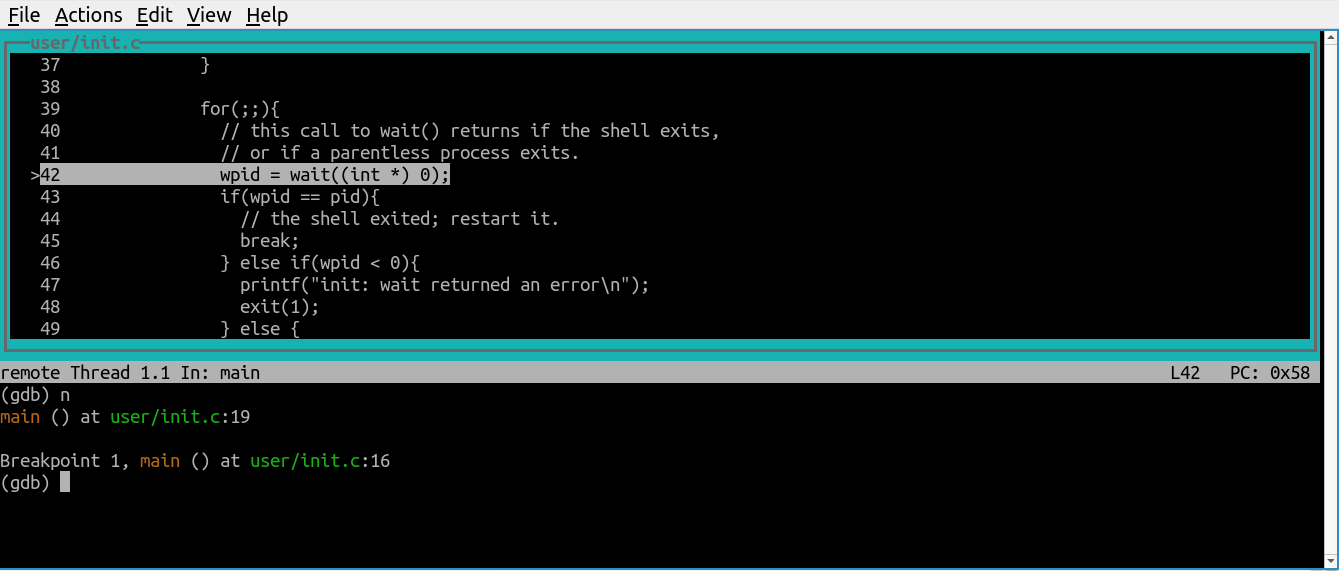
调试第一个进程
首先退出qemu和gdb,查看init程序的入口地址(Entry point address)
1 | grand@Lubuntu ~/xv6-labs-2020 (dev)> readelf -h user/_init |
- 重新启动qemu和gdb,在入口地址加一个断点,
b *0x0; - 接着,continue,
c; - 然后加载kernel的调试符号,
file user/_init; - 查看源代码,
layout src; - 调试,
n。